
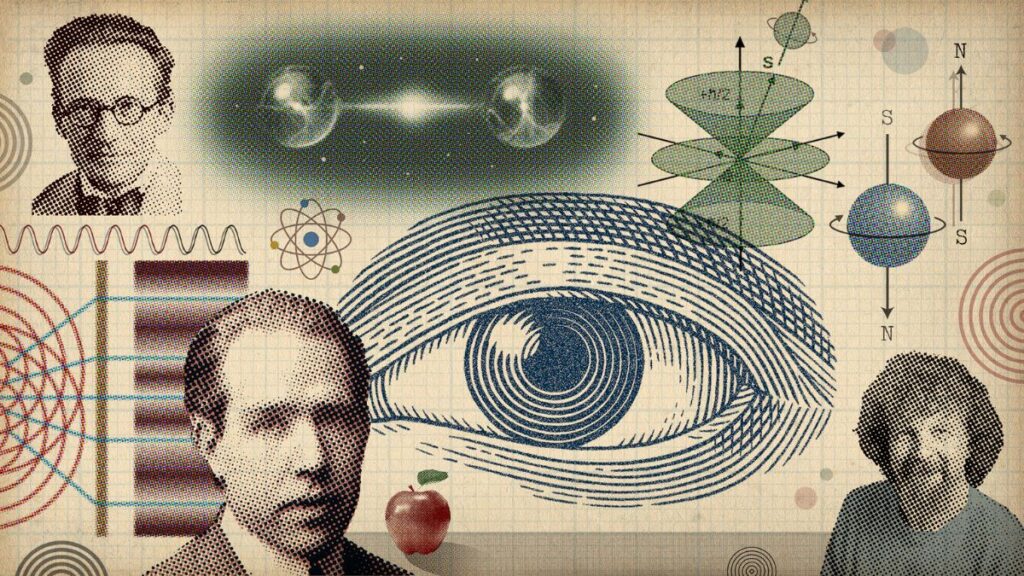
Introduction to Daniel Broglie and his contributions to quantum theory
Daniel Broglie, a name that resonates with the very foundations of quantum mechanics, was not just a physicist; he was a revolutionary thinker. Born in France in 1892, he dared to challenge traditional views about the nature of light and matter. His groundbreaking contributions laid the groundwork for what we now understand as wave-particle duality—a concept that has transformed our grasp on physics.
Broglie’s ideas were bold and visionary. They opened up new realms of scientific inquiry and led to advancements that ripple through various modern fields today. From quantum computing to particle physics, his insights continue to shape our understanding of the universe at its most fundamental level.
As we delve deeper into Daniel Broglie’s life and work, we’ll explore how this pioneer reshaped science’s landscape and left an indelible mark on future generations of researchers. Join us on this journey through time as we uncover the legacy of one man whose theories changed everything we thought we knew about reality itself.
The development of Broglie’s wave-particle duality concept
Louis de Broglie introduced a revolutionary idea in the early 20th century: wave-particle duality. This concept challenged the traditional view of particles and waves as distinct entities.
Broglie proposed that all matter, including electrons, exhibits both particle-like and wave-like properties. His groundbreaking hypothesis suggested that these behaviors depend on how they are observed or measured.
The foundation for this theory lay in the notion of wavelength associated with moving particles. De Broglie’s famous equation linked a particle’s momentum to its wavelength, transforming our understanding of quantum mechanics.
This perspective opened up new avenues for research and experimentation, ultimately leading to the development of quantum mechanics as we know it today. Scientists began exploring phenomena like electron diffraction patterns, which demonstrated the wave nature of subatomic particles.
De Broglie’s work paved the way for future breakthroughs in physics by intertwining classical concepts with emerging quantum ideas.
Exploring the implications of Broglie’s theory on modern physics
Broglie’s wave-particle duality introduced a radical shift in understanding the nature of matter. This concept suggested that particles, like electrons, exhibit both particle-like and wave-like behavior.
Such insights laid the groundwork for quantum mechanics. They challenged classical physics’ rigid boundaries, allowing scientists to explore phenomena previously deemed impossible.
The implications extend far beyond theoretical debates. Broglie’s ideas have paved the way for advancements in technology and research methodologies across various disciplines.
In quantum computing, for instance, this duality is harnessed to develop qubits that can exist simultaneously in multiple states. The potential applications are vast and transformative.
Furthermore, his principles influence our comprehension of subatomic particles within high-energy physics experiments. Understanding these interactions helps unravel the complexities of our universe at its most fundamental level.
Applications in fields such as quantum computing, particle physics, and cosmology
Broglie’s wave-particle duality has paved the way for groundbreaking advancements in quantum computing. This technology leverages qubits, which can exist in multiple states simultaneously, thanks to the principles Broglie introduced. The potential for faster processing speeds and enhanced problem-solving abilities is revolutionizing industries.
In particle physics, Broglie’s theories provide a framework for understanding subatomic particles through their wave-like behavior. Experiments at facilities like CERN rely on these concepts to explore fundamental forces and matter’s origin.
Cosmology also benefits from his insights, as scientists investigate how quantum mechanics influences the universe’s structure and evolution. Concepts derived from Broglie’s work are essential in explaining phenomena such as cosmic microwave background radiation and black holes.
These applications highlight the enduring relevance of Daniel Broglie’s contributions across various scientific domains, shaping our understanding of reality itself.
Controversies surrounding Broglie’s theories and their impact on the scientific community
Daniel Broglie’s wave-particle duality concept stirred considerable debate within the scientific community. While many embraced his groundbreaking ideas, others were skeptical. The integration of waves into particle physics challenged traditional perspectives.
Some physicists struggled to accept that particles could exhibit both wave-like and particle-like characteristics. This tension sparked intense discussions and disagreements among contemporaries, including Albert Einstein and Niels Bohr. Their differing views on quantum mechanics highlighted the uncertainties surrounding Broglie’s theories.
Moreover, Broglie’s work laid the groundwork for future developments in quantum mechanics but also faced criticism for its abstract nature. Critics argued that it lacked empirical support at the time.
Despite these controversies, his ideas spurred further research and exploration in quantum theory. They ultimately shaped how scientists approached complex phenomena in physics, emphasizing the importance of theoretical frameworks alongside experimental validation.
Legacy and recognition of Daniel Broglie’s work in the field of quantum mechanics
Daniel Broglie’s contributions to quantum mechanics have left an indelible mark on the scientific community. His wave-particle duality concept fundamentally transformed our understanding of light and matter.
Recognized with the Nobel Prize in Physics in 1929, his theories laid the groundwork for advances that followed. They inspired a generation of physicists to delve deeper into quantum phenomena.
Broglie’s ideas continue to resonate within modern physics, influencing research in areas like particle physics and quantum computing. His vision shaped key concepts that drive contemporary technological advancements.
Institutions across the globe celebrate his legacy through lectures, publications, and memorials. Scholars frequently reference his work as they explore the boundaries of reality itself.
Daniel Broglie’s influence remains strong, reminding us how one mind can change our perception of the universe forever.
Conclusion
Daniel Broglie’s contributions to quantum theory have reshaped our understanding of the universe. His groundbreaking wave-particle duality concept opened new pathways in physics, allowing scientists to explore the intricate nature of matter and energy. The implications of his theories extend far beyond theoretical applications; they are foundational in fields like quantum computing, particle physics, and even cosmology.
While Broglie’s work faced controversies and challenges from some contemporaries, it ultimately carved out a vital space within scientific discourse. Today, we recognize him as a pioneer whose ideas laid the groundwork for modern advancements in quantum mechanics.
The legacy of Daniel Broglie lives on through ongoing research and technological innovations inspired by his insights. As we continue to delve into the mysteries of the quantum world, Broglie’s vision serves as both a historical touchstone and an enduring source of inspiration for future generations.